The Wisdom of King Solomon by Haim Shapira
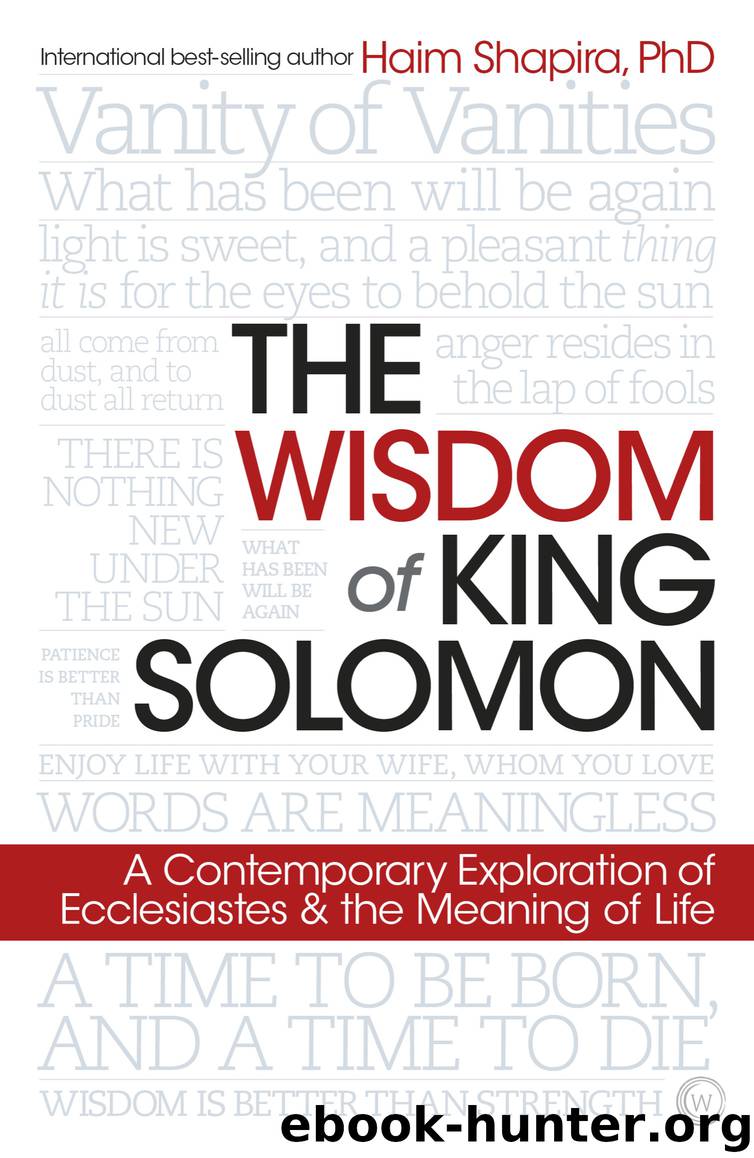
Author:Haim Shapira
Language: eng
Format: epub
Publisher: Watkins Media
CHAPTER 6
JUSTICE AND FAITH
Synopsis
This chapter is about law and justice. The first part addresses people’s attempts to establish just regimes under the sun. The second part is devoted to the Book of Job, which will help us in our examination of divine law and justice and how they are associated with faith and the love of God.
On Law and Justice: An Admonition
And moreover I saw under the sun the place of judgement, that wickedness was there; and the place of righteousness, that iniquity was there.
I said in mine heart, “God shall judge the righteous and the wicked, for there is a time there for every purpose and for every work.”
Ecclesiastes 3:16–17
Ecclesiastes does not believe in a person’s moral sense, and finds corruption everywhere. To him, even courts are corrupt and iniquity resides there.
Millennia before us, Ecclesiastes realized that humans always fail at establishing just regimes. He knew people never succeeded in doing so in the past, nor did he envision that great success awaits us in this field in the future. Human history clearly and visibly corroborated Ecclesiastes’ speculation. Furthermore, humans have lost all hope of establishing any form of just regime, as can be witnessed from the fact that the courts they have established (under the sun) are not charged with doing justice at all. Their only role is to uphold the law.
Even Clarence Darrow (1857–1938), a prominent American lawyer and libertarian, said: “There is no such thing as justice – in or out of court.”
But why is it impossible to establish a just regime, you may ask? Because in most cases, the just are not strong, and the strong are not particularly interested in being just.
Being unable to make what is just strong, we have made what is strong just.
Blaise Pascal
In reality, the strong – those who assume power by force or through democratic elections – introduce laws that benefit them and their like. Although some of the laws they enact treat all the people equally, that is only in appearance. Referring to this point precisely, French Nobel laureate and writer Anatole France wrote in Le lys rouge that the law is gloriously and ironically equal in banning both the poor and the rich from begging in the streets, stealing bread and sleeping under bridges.
I find this assertion by France more profound than it originally seems.
The Veil of Ignorance
John Rawls, American moral and political philosopher and a Harvard professor, is the author of A Theory of Justice – a book many believe is groundbreaking in political philosophy. In this work he presents several interesting thought experiments, the most famous of which is known as the “veil of ignorance”. In this experiment, Rawls developed principles of justice (as he saw them, of course) using an artificial idea that he called the “original position”. According to this concept, all decision-making processes take place behind a veil of ignorance, so that those who make the decisions know next to nothing about the colour of their own skin, their social status, mental abilities, state of health, gender, age and so on.
Download
This site does not store any files on its server. We only index and link to content provided by other sites. Please contact the content providers to delete copyright contents if any and email us, we'll remove relevant links or contents immediately.
| Anthropology | Archaeology |
| Philosophy | Politics & Government |
| Social Sciences | Sociology |
| Women's Studies |
The remains of the day by Kazuo Ishiguro(9005)
Tools of Titans by Timothy Ferriss(8403)
Giovanni's Room by James Baldwin(7353)
The Black Swan by Nassim Nicholas Taleb(7137)
Inner Engineering: A Yogi's Guide to Joy by Sadhguru(6799)
The Way of Zen by Alan W. Watts(6621)
The Power of Now: A Guide to Spiritual Enlightenment by Eckhart Tolle(5790)
Asking the Right Questions: A Guide to Critical Thinking by M. Neil Browne & Stuart M. Keeley(5779)
The Six Wives Of Henry VIII (WOMEN IN HISTORY) by Fraser Antonia(5519)
Astrophysics for People in a Hurry by Neil DeGrasse Tyson(5196)
Housekeeping by Marilynne Robinson(4455)
12 Rules for Life by Jordan B. Peterson(4312)
Ikigai by Héctor García & Francesc Miralles(4279)
Double Down (Diary of a Wimpy Kid Book 11) by Jeff Kinney(4278)
The Ethical Slut by Janet W. Hardy(4262)
Skin in the Game by Nassim Nicholas Taleb(4257)
The Art of Happiness by The Dalai Lama(4133)
Skin in the Game: Hidden Asymmetries in Daily Life by Nassim Nicholas Taleb(4012)
Walking by Henry David Thoreau(3969)
